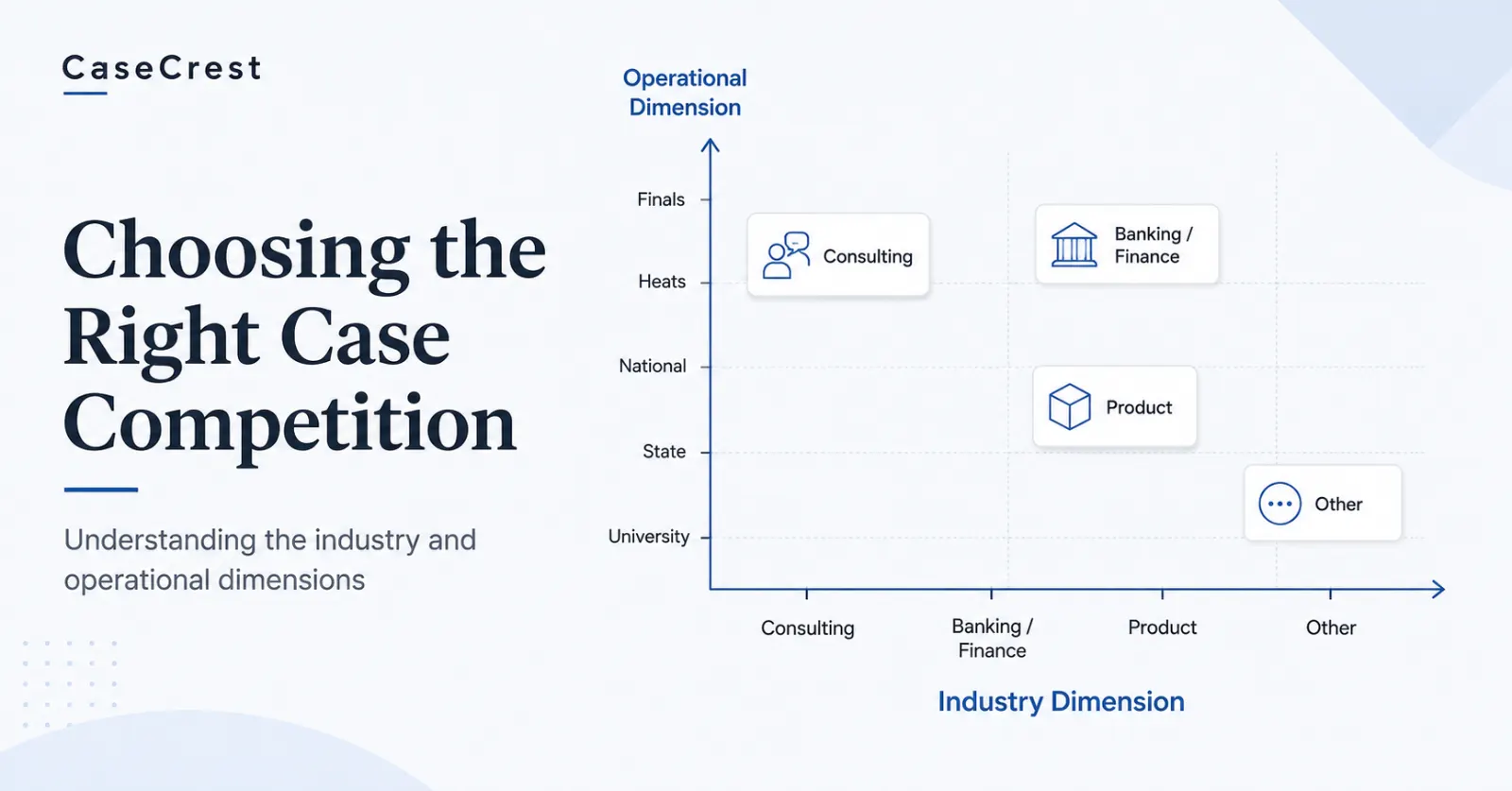
When it comes to case competitions, they can be dimensional in two aspects: in terms of their industry focus and the way they operate. CaseCrest does offer a variety of filters to help you decide on what competitions you should do. We also have resources relevant to each industry and further insights into how these competitions operate, so make sure to read the list of our resources that are freely available to you.
Industry dimension:
Case competitions generally fall into consulting, banking/finance, product and then everything else which can include marketing, human resources, startup, pitches and more.
This isn't exhaustive by any means, but it does allow you to have a clearer understanding of the different competitions out there. Depending on what you're interested in learning more about or up skilling into, it will greatly help to focus on those as they will help you better align your CV and resume to the types of things you try to do.
Consulting competitions are generally focused on some kind of transformation, new financing strategies and efficiency discovery, even figuring out pathways to improve certain business outcomes. They can be really broad in terms of their scope and requirements however, the case brief will clearly outline key considerations for you, taking into account what they're expecting of you.
Banking/finance competitions are a little bit more straightforward, as they generally ask you to evaluate a merger and acquisition, pitch a stock, and model some kind of quantitative metrics heavily. Of course, they are very finance-heavy, requiring extensive modelling as apart of the core work product you submit. It's a great way to build up these core competencies, which you'll generally use in the industry to get familiar with tools, jargon and other terms.
Product focused competitions are probably the most broad, as it can range from developing a new product line, evaluating brand perception and can span many different industries, whether it be FMCG, services, not-for-profits, and more.
Operational dimension:
In regards to what operational dimension means a bit more clearly, I'm referring to the different ways rounds may be configured, deliverables required and scale/location they're operating in.
Working backwards in regards to scale, there are generally university-only comps and those can be even limited to certain year groups of students such as first year or penultimate students only. Also, might see geographic restrictions where they scope to the city they're based in, the state that they're based in, or even the entire country. I've seen competitions that are UNSW only, Sydney only, New South Wales only, Australia only, or trans-Tasman (so Australia and New Zealand). They can be very varied and broad.